\ 4K Ultra HD TV guide

2014年6月19日星期四

What if the content being watched is not 4K Ultra HD?

Even if your existing content is not currently available in 4K Ultra HD, you can still enjoy a higher resolution picture compared to 720p and 1080p TVs by upscaling your current content. Upscaling is accomplished by a video processing chip which adds details to your native content to utilize the higher resolution of your 4K Ultra HD TV.
4K Ultra HD TVs include a video processing chip that upscales your content; however, upscaling capabilities will vary in quality across models and brands. 4K Ultra HD TVs without an internal upscaler would require theupscaling capabilities will vary in quality across models and brands use of an external upscaler to improve the picture resolution. External upscaling can be found in some Blu-ray players and receivers. Using an upscaling Blu-ray player or home theater receiver without a 4K Ultra HD TV will not improve your picture quality on a non-4K Ultra HD TV. Current 4K Ultra HD projectors may also require an external 4K upscaler - check the projector specifications to be sure.


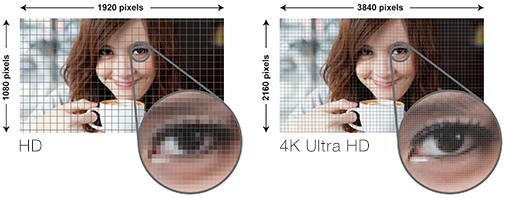
What is 4K Ultra HD?

4K Ultra HD is a new class of high-definition resolution offering unprecedented picture clarity and detail. Although the technology was already in use in film production and movie theaters, it is just now coming home to the television, offering nearly 4,000 (or “4K”) pixels across the screen’s horizontal.
Before 4K Ultra HD arrived, the highest-definition resolution on the TV market was Full HD 1080p, which consisted of 1920 x 1080 pixels, thus giving it its “1080p” name. 4K Ultra HD has four times the number of pixels as Full HD (3840 x 2160 pixels, or 4096 x 2160 pixels for cinema screens), resulting in its “4K Ultra HD” title. The increased resolution...even up close images seem clearer, more realistic, and less pixilated.made possible by 4K Ultra HD’s 8.3 million pixels (vs. Full HD’s 2.2 million) enhances picture quality by reducing gaps between pixels (called the “screen door” effect) and visible pixels (called “jaggies”). This sharpens detail and shows smoother lines so that even up-close images seem clearer, more realistic, and less pixilated.
Besides enhancing your viewing experience, higher resolution 4K Ultra HD TVs also allow you to sit closer to a screen and/or view a larger screen without seeing pixilation of scenes. That’s why it’s possible for manufacturers to make larger TVs with screen sizes of 80 inches and above while still providing excellent picture quality. By enabling superior picture quality on large screens and enhanced picture quality even up close, 4K Ultra HD technology gives you more freedom in your home to sit wherever you like and watch on a larger screen without compromising clarity. All in all, the enhanced resolution in 4K Ultra HD products helps deliver a more detailed, immersive, and realistic entertainment experience.
Shop all 4K Ultra HD TVs
4K resolution helps improve picture quality by minimizing the "screen door" effect.
Image provided by Sony